
Today’s date is shown below in numbers and written formats. You can view and copy the current date in American, British, European and international ISO formats.
The date is generated automatically using the date and timezone on your device.
TODAY’S DATE
What is today’s date?
Today’s date is displayed above in several commonly used formats.
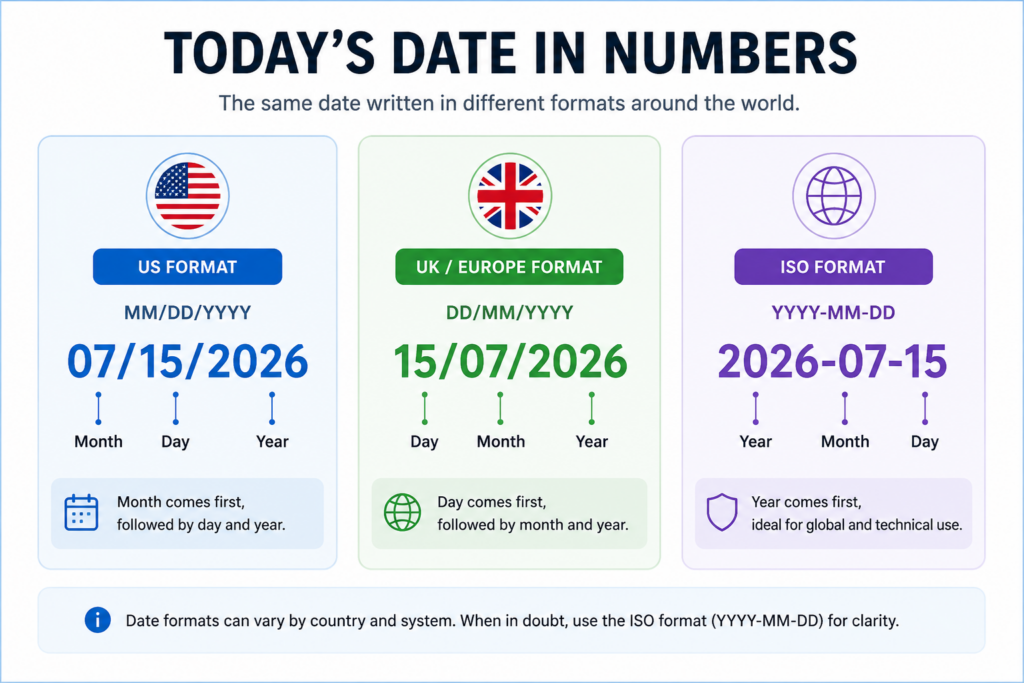
In the United States, dates are normally written with the month first, followed by the day and year. This is called the MM/DD/YYYY format.
In the United Kingdom and many other countries, the day is written first. This is called the DD/MM/YYYY format.
For international, technical and database use, the date is often written as YYYY-MM-DD, following the international ISO 8601 date and time standard.
Today’s date in different numerical formats
The same date can be written in several ways depending on the country, organization or computer system using it.
| Date format | Order | Common use |
|---|---|---|
| MM/DD/YYYY | Month, day, year | United States |
| DD/MM/YYYY | Day, month, year | United Kingdom, Europe and many other countries |
| YYYY-MM-DD | Year, month, day | ISO 8601, databases and international use |
| MM-DD-YYYY | Month, day, year | Alternative US numerical format |
| DD-MM-YYYY | Day, month, year | Alternative international format |
| YYYYMMDD | Year, month, day | Compact technical format |
| MM/DD/YY | Month, day, short year | Short US format |
| DD/MM/YY | Day, month, short year | Short international format |
Use the copy buttons in the date tool to copy the format you need.
Today’s date in MM/DD/YYYY format
The MM/DD/YYYY format places the month before the day.
For example, July 15, 2026 is written as:
07/15/2026
This date order is used mainly in the United States. The first two digits represent the month, the next two represent the day, and the final four represent the year.
The YYYY-MM-DD format follows the international ISO 8601 date and time standard.
Today’s date in DD/MM/YYYY format
The DD/MM/YYYY format places the day before the month.
For example, July 15, 2026 is written as:
15/07/2026
This order is common in the United Kingdom, Europe, Australia and many other parts of the world.
Today’s date in YYYY-MM-DD format
The international ISO date format writes the year first, followed by the month and day:
YYYY-MM-DD
For example, July 15, 2026 is written as:
2026-07-15
This format is useful because it is clear, internationally recognizable and sorts correctly in chronological order when used in filenames, databases and spreadsheets.
Should today’s date include leading zeros?
A numerical date can be written with or without leading zeros.
For example:
- 07/05/2026 uses leading zeros.
- 7/5/2026 does not use leading zeros.
Both may be understood in everyday writing, but fixed-width formats usually include leading zeros. They are especially useful in forms, databases, spreadsheets and computer systems.
Slashes, hyphens and dots in numerical dates
Dates can use different separators:
- Slashes: 07/15/2026
- Hyphens: 07-15-2026
- Dots: 07.15.2026
- No separator: 07152026
The separator does not usually change the date order. It only changes how the date is displayed.
For international or technical use, YYYY-MM-DD is normally the clearest choice.
Why can dates written in numbers be confusing?
A date such as 03/10/2026 can have two different meanings:
- In MM/DD/YYYY format, it means March 10, 2026.
- In DD/MM/YYYY format, it means October 3, 2026.
When the intended audience may use different date conventions, write the month as a word or use the year-first ISO format.
For example:
- March 10, 2026
- 10 March 2026
- 2026-03-10
These forms are less likely to be misunderstood.
How to write today’s date with the weekday
In American English, the weekday normally appears before the month:
Wednesday, July 15, 2026
In British English, the day normally appears before the month:
Wednesday, 15 July 2026
A comma is commonly placed after the weekday. In American English, another comma is placed between the day and year.
Written and abbreviated date formats
Dates can also use abbreviated month names.
Examples include:
- Jul 15, 2026
- 15 Jul 2026
- Wednesday, Jul 15, 2026
- Wed, 15 Jul 2026
Writing the month as a word can make the date easier to understand when readers may use different numerical date orders.
Today’s date, local time and timezone
The date preview at the top of this page uses your device’s local date and timezone. This is important around midnight because the calendar date can differ between countries and time zones.
Coordinated Universal Time is maintained internationally and explained by the National Institute of Standards and Technology.
You can also check the current local time or see the current week number.
Frequently asked questions
What is today’s date in numbers?
Today’s date appears at the top of this page in MM/DD/YYYY, DD/MM/YYYY, YYYY-MM-DD and several other numerical formats.
What is the American date format?
The standard American numerical date order is MM/DD/YYYY. The month appears first, followed by the day and year.
What is the British date format?
The common British numerical date order is DD/MM/YYYY. The day appears first, followed by the month and year.
What is today’s date in ISO format?
The ISO date format is YYYY-MM-DD. The current ISO date is displayed in the date preview at the top of this page.
What is today’s date without slashes?
The current date without slashes is available in compact US, international and ISO formats in the date preview.
Is the date on this page updated automatically?
Yes. The displayed date is generated from the date and timezone configured on your device. It updates automatically when the day changes.
Which date format is least ambiguous?
The year-first YYYY-MM-DD format is generally the clearest numerical format for international and technical use.
More useful date tools
Use these related tools to find other dates and calendar information: